Our Vision & Mission
Short answer: save lives, eat plants.
Three reasons. Each one enough on its own.
Together, they are everything.
first & foremost: our fully sentient family & friends
Our fellow Earthlings: a unique collective of co-conscious individuals
Though we may not sound, swim, slide, soar or seem the same, we are similar in all the ways that matter.1 We all share universal and timeless instincts such as love and fear.2 There is a growing abundance of science supporting their sentience and even congruent complicated characteristics such as culture, altruism, and mourning.3,4,5
Yet, all it takes is empathic observation and your good old gut feeling to understand our fellow fluffy, furry, feathered and finned Earthlings are more than mere objects for entertainment, experiments, fashion or food.1
As food contributes to over 95% of animal suffering, by slaughtering some 5,000 souls per second, 24/7/365, the major key to a kinder world is one meal at a time.6,7
There Is No Planet B (for now... and even if!)
There's no planet B (for now) so let's treat her like that. And even if there is one, why not still try to treat her right by eating plants to save lives? 42% of US cropland (now fed to cattle) could be retained, 80% of rainforest deforestation halted, 92% of freshwater sources spared.9,10
Ending animal agriculture is the simplest solution to the world's biggest challenges: climate change, ocean acidification, ocean dead zones, deforestation, biodiversity loss, water waste, world hunger, obesity, diabetes, antibiotic resistance, heart & coronary diseases, zoonotic diseases and animal cruelty at a global industrial scale.11,12,13,14
That is why Liefs’ mission is to ‘promote plant-based products to normalise conscious consumption’.
Your Health, your other home
As beautifully full circle as Mother Nature’s planets: eating healthy is healthier for her and her animals too
Whether it's our immune system, various enzyme systems, carcinogens, hormonal activity, insulin, brain function, heart and arteries, people whose diets are high in animal protein have significantly higher rates of chronic disorder: hypertension, cancer, diabetes, heart disease, cataracts, diverticulosis, inflammatory bowel disease, gall bladder disorders, gout, kidney stones, and rheumatoid arthritis.15,21,22,23
Thousands of original studies and hundreds of meta-analyses conclude animal products and protein are linked to chronic disorders and premature death.17,18 Cancer is clearly and positively linked with eating animal foods.19
Even conservative institutions like the FDA, the American Dietetic Association, the British Dietetic Association, and Oxford University recognize and recommend plant-based diets as healthy in all stages of life.15,20
Isn't it beautifully wholesome that doing well to the animals and our planet, also seems to do well to our bodies?
FAQ * Frequently Asked Questions
From B12, iron & soy, to almonds, bees, the Amazon & beyond
People
Legumes, tofu, tempeh, whole grains, nuts and seeds. A varied plant-based diet provides all essential amino acids.
No. Muscle growth depends on total protein and training, not the source. Studies show equal strength and muscle gains.
B12 is made by bacteria, not animals. Farm animals are usually supplemented with it too, so vegans simply take it directly.
Yes. Plant-based athletes compete at elite level in endurance, strength and power sports.
No. Bones need calcium, vitamin D, protein and weight-bearing exercise, all available on a vegan diet.
No. Legumes, whole grains, seeds and greens are rich in iron. Vitamin C boosts absorption, and the body regulates plant iron more safely.
No. Human studies show soy does not feminise men or disrupt hormones, and it is linked to a lower cancer risk.
Planet
No. Regenerative grazing still uses more land and water and emits more methane per calorie than plant farming. It cannot feed 8 to 10 billion people.
No. About 75% of global soy is grown to feed livestock. Eating soy ourselves reduces deforestation.
Not really. Most emissions come from the animals themselves; transport is a small share. Even small farms use more land and water than plant foods.
No. Per liter, dairy uses more water and land and emits more greenhouse gases.
Animals
Bees make honey as their own winter food. A worker bee makes about one twelfth of a teaspoon in her lifetime. Harvesting it stresses the colony, and queens often have their wings clipped to stop them leaving.
Selective breeding makes hens lay 250 to 300 eggs a year, draining calcium and causing weak bones and reproductive disease. Most hens come from hatcheries that kill male chicks.
Standards vary, but the animals are still used, controlled and killed once no longer profitable. Exploitation in a nicer setting is still exploitation.
Taking a life when it is not necessary is still violence. Farm animals are killed young, as soon as they are fully grown, because keeping them longer costs money.
Yes, but a lion kills to survive. We have other options.
More debunked myths & recipes in our book and our free sample guide
If you like the free guide, please support our vision & mission by gifting yourself or a loved one a book, which always is a gift that keeps on giving.
The independent science behind our why
The small numbers in the text refer to the peer-reviewed sources below. Our bibliography of 178 references can be found on pages 212–227 of ‘Meals for Life: Award-Winning Recipes & Reasons to Raise a Family of Vegans.’ See eatatliefs.com/book
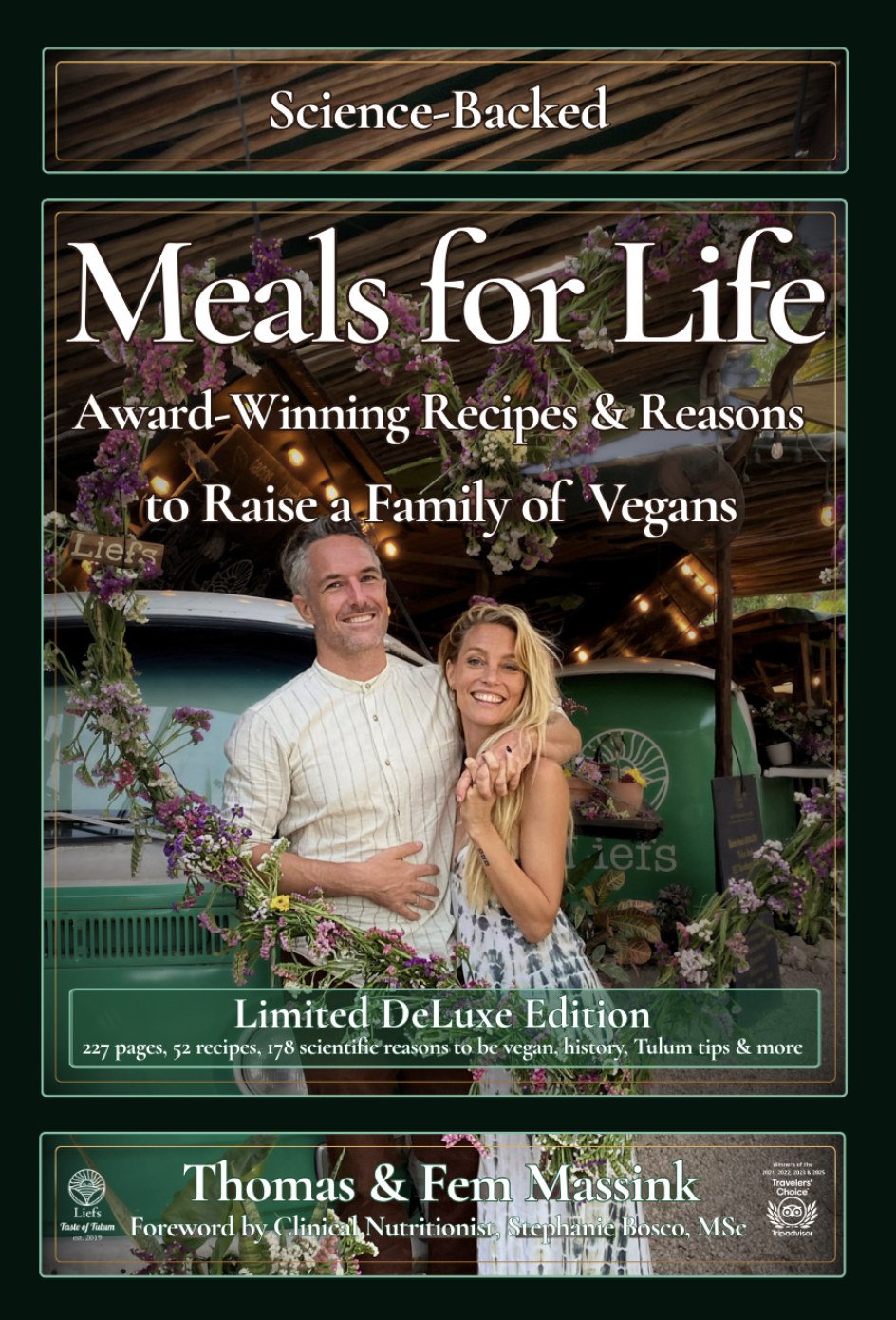
Our latest book, Meals for Life, contains 178 independent, peer-reviewed scientific references, 50+ award-winning recipes, our complete family & Liefs founding story, and a practical guide to transition towards a plant-based lifestyle and even raising a vegan family from birth. Basically everything we know, no gatekeeping.
Look inside Meals for LifeStay in the loop
Recipes, gifts, early dates & a little wisdom, straight to your inbox. No spam, ever.
Also at Rancho Verde
Rancho Verde Tulum, our zero-waste jungle sanctuary, is available for retreats, weddings, private events and Airbnb stays. Airbnb Superhost & Guest Favorite since 2024.